OCT Agent

OCT Agent is the desktop agent layer for Awareness Memory. It is designed for long-running work where the assistant should remember project context, decisions, preferences, and working habits across conversations instead of starting cold every time.
The name comes from the octopus. An octopus has strong memory, independent arms, and a nervous system that coordinates local action with whole-body intent. OCT Agent uses that metaphor for AI work: durable memory as the nervous system, multiple agents as the arms, and the desktop workspace as the body that keeps everything coordinated.
What OCT Agent Does
| Capability | What it means in practice |
|---|---|
| Persistent memory | Recalls prior work, project decisions, and user preferences across sessions. |
| Multi-agent workspace | Coordinates research, coding, review, and planning agents without repeating the same context. |
| Agent marketplace | Installs community agents and workflow packs, then remembers their permissions and setup notes. |
| Local-first desktop | Keeps the product close to the user's machine and daily tools. |
| Chat-tool compatibility | Connects the same memory layer to multiple chat surfaces and agent runtimes. |
| Open-source building | Welcomes contributors to improve the desktop, memory loop, connectors, and workflows. |
Product Shape
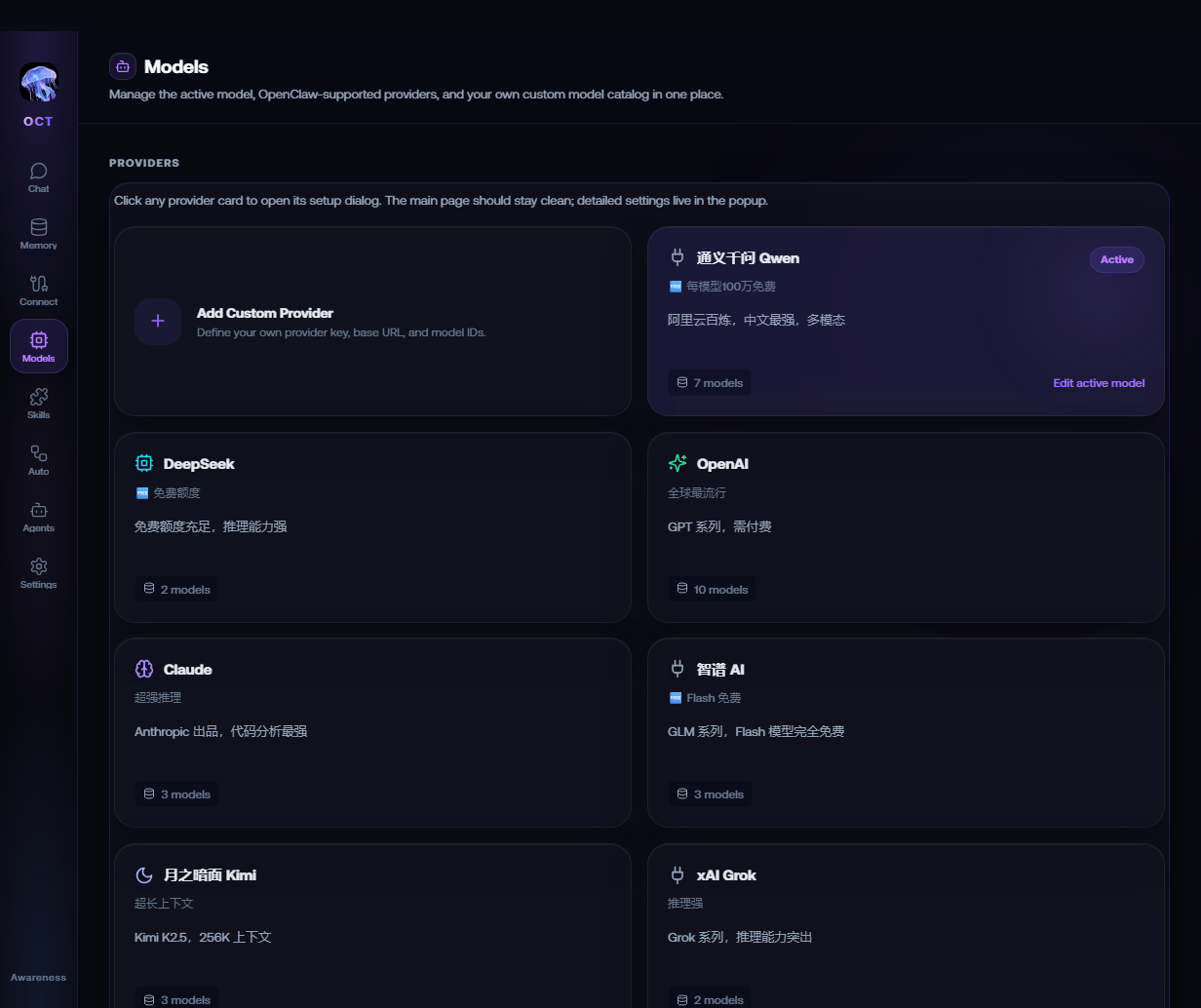
OCT Agent is not just a chat window. The product surface is built around a persistent workspace:
- The left side keeps agents, workflows, and memory spaces easy to scan.
- The Models page lets users manage OpenClaw-supported providers, activate a model, and add custom providers without leaving the desktop.
- The memory layer stays visible enough to build trust without becoming a second app inside the app.
- The installer and release flow are meant to make the first run feel like installing a native assistant, not wiring up an SDK.

Why It Matters
Most AI tools are powerful in the current conversation but forgetful across the week. OCT Agent turns Awareness Memory into a daily agent environment, so the assistant can carry forward:
- Previous decisions and tradeoffs.
- Project-specific preferences.
- Repeated workflows and agent roles.
- Files, commands, and local context.
- Collaboration history from other tools.
That makes OCT Agent especially useful for research, coding, product planning, and multi-agent execution where context continuity matters more than a single impressive answer.
Open Source
OCT Agent is open source and welcomes builders.