The quota disappears before the work does
If you use Claude Code, Cursor or ChatGPT for real work, you know the pattern: the first hour feels unlimited, then the limit arrives while you are still in the middle of the task.
The usual explanation is "the model is expensive." That is true, but incomplete. The bigger problem is that most of what you send on every turn is not new work. It is the same project background, the same decisions, the same error message, and the same instructions — replayed again and again.
You are not paying for the new question. You are paying to remind the model of everything it should already know.
The math of re-sent context
A long agent session is a loop:
- You send the system prompt, tool definitions, and conversation history.
- The model replies.
- The next turn sends the system prompt, tool definitions, history plus the previous reply.
- Repeat.
The input grows with every turn. A 40-turn session does not cost 40 questions; it costs the sum of 1 + 2 + 3 + ... + 40 turns of context. The later turns are the most expensive ones — exactly when you are doing the most useful work.
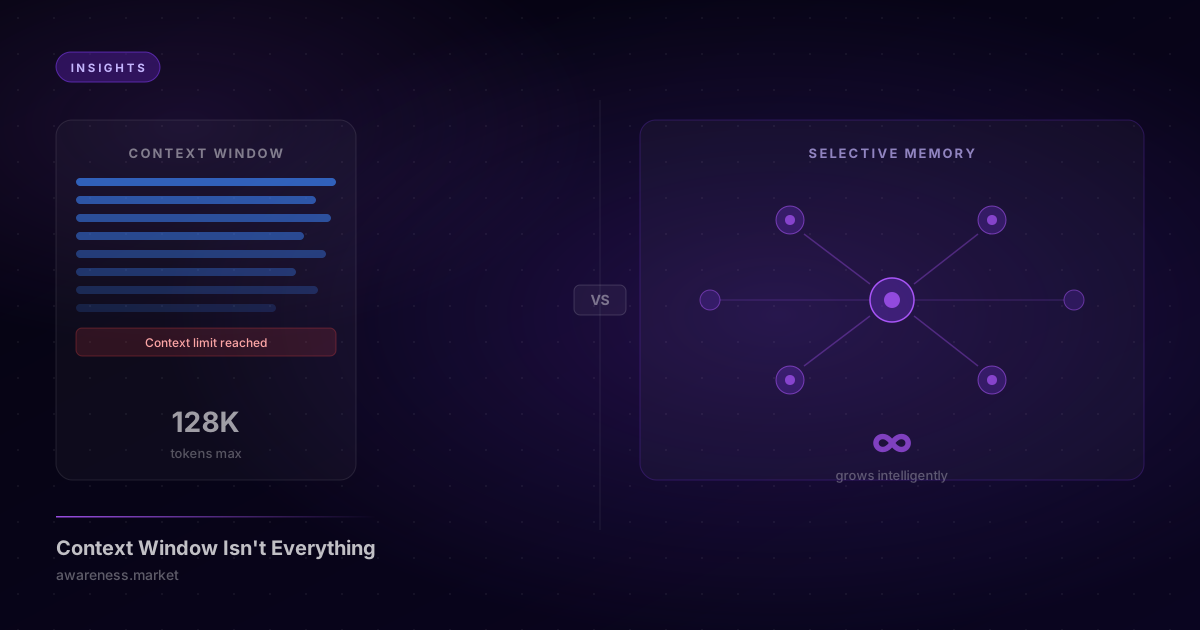
This is why "just use a bigger context window" does not solve the quota problem. A larger window lets you send more, and then charges you for sending more. It also makes each turn slower and increases the chance that the important detail gets lost in the middle.
What actually reduces the burn
The fix is not a bigger window. It is sending less irrelevant context.
Instead of replaying the whole session, keep durable knowledge outside the model:
- decisions and their reasons
- project conventions and constraints
- user preferences
- known failures and their fixes
- the current task state
Then, on each turn, retrieve only the slice that matters for the current request. The model still gets what it needs; it stops getting everything.
This is the difference between a context window and a memory layer. The window is what you can afford to send in one request. The memory layer decides what is worth sending at all.
What this looks like in practice
Awareness is a local-first memory layer that speaks MCP. It stores memory in SQLite on your machine and exposes it to the agent as tools. When the agent needs context, it recalls the relevant cards instead of replaying the session.
It works with the agent you already use — Claude Code, Cursor, ChatGPT, or any MCP-capable client — and with the model you can use: Claude, GPT, DeepSeek, Qwen, Kimi, or a local model. Awareness itself has no regional lock and no usage-based fee, because it does not run inference and does not resell model tokens.
What it does not do:
- It does not give you more model quota. Your provider still sets that.
- It does not bypass regional access controls. That is between you and your provider.
- It does not magically compress a prompt you insist on sending in full.
It reduces the tokens you spend on repeated context. That is the part you control.
Measure it, do not trust a percentage
Every "saves 60% of tokens" claim is meaningless without your workload. The only number that matters is the one measured on your sessions.
Awareness records token savings per retrieval: the candidate pool it considered versus the context it actually assembled. After a few real sessions, open the dashboard and look at your own numbers. If the savings are not there for your workflow, uninstall it. That is the correct test.
Try it
npx @awareness.market/local start
It runs locally, needs no account, and stores memory in SQLite. The cloud sync is optional. If you are hitting limits every week, start by measuring where the tokens actually go — then decide whether a memory layer is the right fix.
The goal is not unlimited usage. The goal is to stop paying for the same context twice.