The Arms Race Nobody Asked For
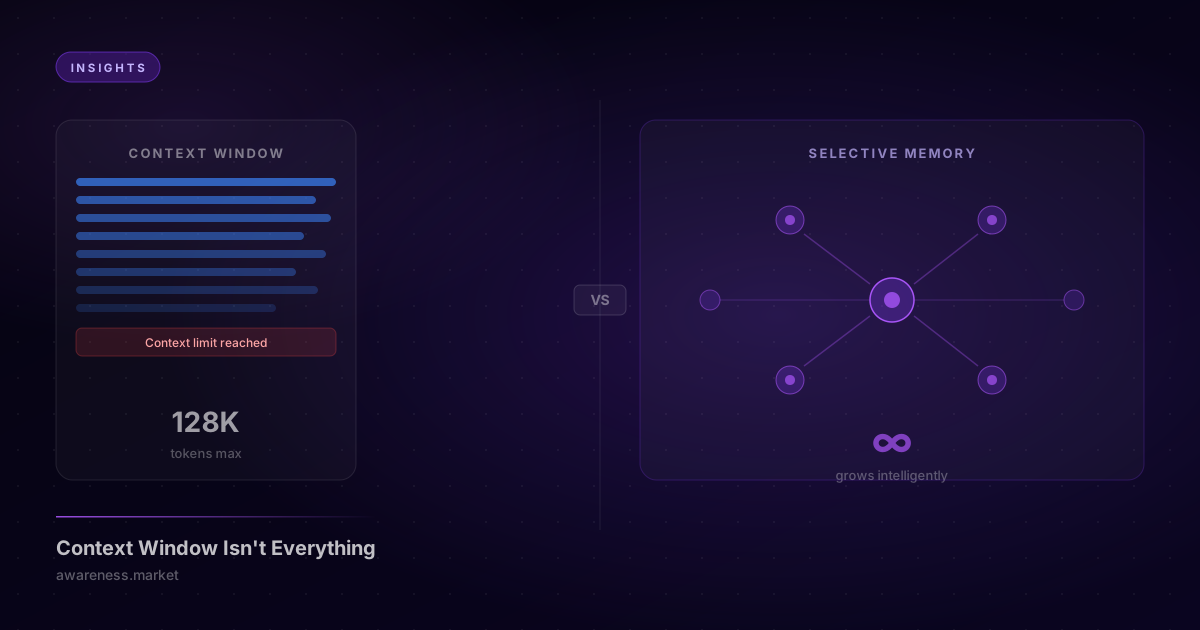
Every few months, a new LLM ships with a bigger context window. 128K tokens. 200K. 1M.
The promise is always the same: now your AI will finally remember everything.
But if you've spent real time building with Vibe Coding tools, you've probably noticed: bigger windows don't actually solve the forgetting problem. They just delay it — and create new ones.
What Actually Happens at 200K Tokens
Here's something the benchmarks don't tell you: LLMs get worse as the context gets longer, not better.
This phenomenon — sometimes called the "lost in the middle" problem — is well-documented. When you give a model 200,000 tokens of context, it reliably pays much more attention to the beginning and end of the input. The crucial architectural decision you mentioned at position 87,432? The model likely glossed over it.
The attention distribution problem
Think of attention in a transformer model like a spotlight in a dark room. With a small room (small context), the spotlight can illuminate everything fairly evenly. As the room gets bigger, the spotlight has to spread thinner — and certain corners go dark.
More concretely: if you give Claude or GPT-4 a 150K token codebase and ask it to find a subtle bug, it will consistently miss things that a focused 20K token prompt would catch.
Why "More Context" Is a Lazy Solution
There's a deeper problem with the brute-force approach: context isn't free.
Every token you send costs money and latency. A 200K-token prompt:
- Costs ~10x more than a 20K prompt
- Takes 2-5x longer to process
- Returns responses that are often noisier and less focused
For a solo developer or small team doing Vibe Coding, this adds up fast. You're essentially paying to confuse your AI.
The Selective Memory Approach
What actually works is not more context — it's better context.
The core insight: your AI doesn't need everything. It needs the right things.
For any given task, there are usually 3-7 pieces of context that are genuinely relevant:
- The current architectural pattern in use
- Recent decisions that constrain this work
- The specific conventions for this module or feature
- Known edge cases or gotchas
Everything else — the full codebase, the complete conversation history, the documentation for libraries you're not using right now — is noise that actively hurts performance.
How selective retrieval works
A memory system like Awareness doesn't dump your entire history into the context window. Instead:
- Your question/task is semantically analyzed
- The memory store is searched for relevance — not just keyword matching, but meaning
- Only the 3-7 most relevant memories are injected into the prompt
- The rest stays in storage, available if needed but not burning tokens
The result: a 20K token prompt that performs better than a 200K token one, because every token counts.
A Concrete Example
Let's say you're working on a new API endpoint. With a raw big-context approach, you might dump in:
- The full codebase (100K tokens)
- All previous conversations (50K tokens)
- Complete API documentation (30K tokens)
Total: 180K tokens, mostly irrelevant.
With selective memory, Awareness surfaces:
- Your API design conventions (1K tokens)
- The authentication pattern your project uses (500 tokens)
- A note you stored about error handling standards (300 tokens)
- The specific service this endpoint connects to (800 tokens)
Total: ~2.6K tokens, all relevant.
The selective approach is 69x more token-efficient — and the AI response is better.
The Compounding Return
Here's what makes this approach genuinely powerful over time: memories compound.
Every architectural decision you document, every convention you store, every edge case you note — it all accumulates into an increasingly useful knowledge base. After three months, your Awareness memory store is worth something.
A fresh context window resets every session. A memory store grows.
This is the difference between working with an AI that's perpetually confused and working with an AI that's been on your team for months.
The Right Mental Model
Stop thinking of context as "what does the model see right now."
Start thinking of memory as "what does my AI know about our project."
The context window is a working memory — temporary, volatile, expensive. A memory system is long-term memory — persistent, searchable, cheap to maintain.
Together, they're more powerful than either alone.
What This Means for Vibe Coding
If you're building with Cursor, Claude Code, or any MCP-compatible tool:
- Document decisions as you make them — store architectural choices, not just code
- Be specific about constraints — "don't use Redux" is more useful than "we use Zustand"
- Tag and categorize memories — make retrieval faster and more precise
- Review and prune periodically — stale memories are worse than no memories
The goal isn't to remember everything. It's to remember the right things, at the right time.
Ready to build a memory system for your AI workflow? Get started with Awareness →